
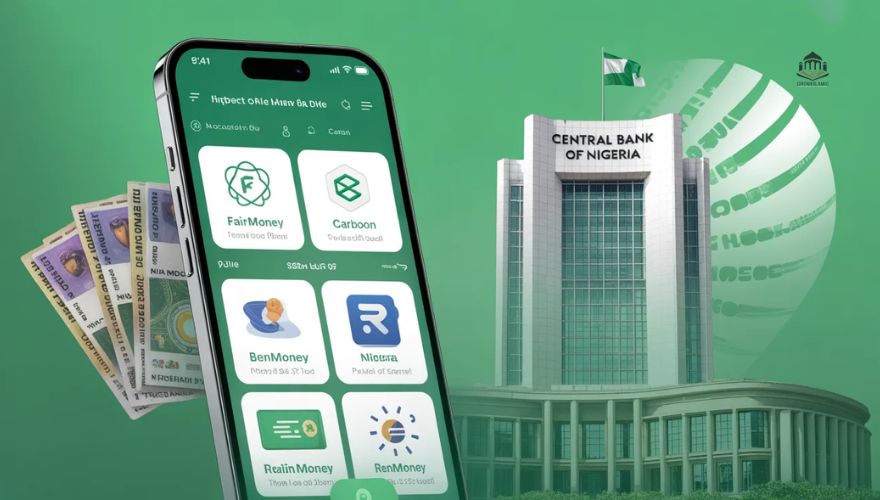
The digital lending sector in Nigeria in the year 2026 will be no longer a gamble but a regulated financial system which is based on trust, transparency and consumer protection. The new law-abiding attitude of the borrowers under more supervision by the Central Bank of Nigeria has led to the appreciation of the long term safety, ethics and legality of borrowing other than instant cash. This list of Loan Apps Approved by CBN will enable Nigerians to determine safe sites that comply with the requirements of the regulator and avoid unlawful and unscrupulous lenders.
In addition to the approval status, we also study CBN approved loans applications, revised interest rates, privacy policies, and ethical aspects of Muslim borrowers. In case of emergency deposits or to finance a business, knowledge of licensed digital lenders in Nigeria and non-interest loans is important.
The 2026 Regulatory Revolution: Why Compliance is Non-Negotiable
As of January 5, 2026, the FCCPC has enacted a total “clean-up” of the Nigerian digital lending space. Any app that failed to meet the new 2026 capital requirements and data privacy standards was delisted from the Google Play Store and Apple App Store.
Key Protections You Now Enjoy in 2026:
- The Anti-Harassment Law: Under the 2026 enforcement measures, any lender caught “shaming” a borrower by contacting their friends or family is immediately stripped of their license.
- GSI (Global Standing Instruction) 2.0: The CBN has refined GSI. While it allows lenders to recover debts from your other bank accounts, it now forbids them from touching “subsistence funds”—ensuring you are never left with a zero balance for basic needs.
- AI Fairness Audit: All approved apps in 2026 must undergo a quarterly audit of their AI algorithms to ensure that interest rates are not unfairly hiked based on a user’s emergency status.
Updated List of Loan Apps Approved by CBN (2026)
Below is the master directory of the most reliable and fully licensed digital lenders in Nigeria as of January 2026.
| Loan App | Official Provider | 2026 Approval Status | Primary Focus |
| FairMoney | FairMoney Microfinance Bank | Full License | Consumer & SME Loans |
| Carbon | One Finance & Investment Ltd | Full License | Personal Credit Lines |
| Branch | Branch International | Full License | Low-interest Loyalists |
| Renmoney | Renmoney Microfinance Bank | Full License | Salaried Workers (High Limit) |
| QuickCheck | Arve Limited | Full License | Emergency Micro-loans |
| PalmCredit | Newedge Finance Limited | Full License | Fast Disbursement |
| Okash | Blue Ridge Microfinance Bank | Full License | High Approval Rates |
| Kuda Overdraft | Kuda Microfinance Bank | Integrated License | Current Account Holders |
| Umba | Umba Digital Solutions | Full License | Digital Banking/Lending |
| EaseMoni | Blue Ridge Microfinance Bank | Full License | Consumer Retail Loans |
Caution: Always cross-reference the app developer’s name. In 2026, many “clone apps” attempt to mimic FairMoney or Carbon to steal BVN data. Only use apps whose developer name matches the official provider listed above.
The 2026 Interest Rate Landscape: A Price Comparison
Interest rates in 2026 have stabilized due to the CBN’s 2025 Monetary Policy Reforms. However, conventional loans remain expensive compared to traditional bank loans.
2026 Rate Analysis:
| App Name | Monthly Interest Rate | Max Annual Percentage Rate (APR) | 2026 Loan Limit |
| Renmoney | 2.5% – 7% | 30% – 84% | Up to ₦10,000,000 |
| Branch | 3% – 15% | 36% – 180% | Up to ₦2,000,000 |
| FairMoney | 2.5% – 30% | 30% – 260% | Up to ₦3,500,000 |
| PalmCredit | 4% – 12% | 48% – 144% | Up to ₦1,000,000 |
| Carbon | 5% – 25% | 60% – 300% | Up to ₦1,500,000 |
Why do rates vary? In 2026, lenders use Predictive Analytics. If you pay back your first three loans on time, the AI automatically drops your interest rate by up to 5% for the fourth loan.
The Halal vs Haram Debate: A 2026 Islamic Finance Perspective

For the 100+ million Muslims in Nigeria, the legality of a loan in the eyes of the government is secondary to its permissibility in the eyes of the Creator.
Why Conventional Apps are “Haram” (Prohibited):
- Riba (Usury): The most obvious factor. Every app on the conventional list charges interest. In Islam, money is a tool, not a commodity to be rented for profit.
- Gharar (Uncertainty): Many apps have complex hidden fees that change depending on the day you pay back. This level of uncertainty is forbidden in Shariah contracts.
- Exploitation: The Quran prohibits taking advantage of someone’s desperate need. Monthly rates of 20%–30% are viewed as exploitative (predatory) lending.
Is there a “Middle Ground”?
Some scholars in 2026 argue that in cases of “Darurah” (Extreme Necessity)—such as a life-saving medical surgery where no Halal option is available—a Muslim may take the minimum amount required. However, for business growth or lifestyle purchases, conventional apps remain strictly prohibited.
The Rise of Halal Fintech: 2026 Alternatives

The year 2026 has been dubbed the “Year of Non-Interest Banking“ in Nigeria. With the Islamic Finance Market reaching ₦3.5 Trillion, you no longer have to rely on interest-based apps.
How to Get a Halal Loan in 2026: Step-by-Step
A. Lotus Bank (The Digital Choice)
Lotus Bank has become the most technologically advanced non-interest bank in 2026.
- The Product: Murabaha (Cost-plus-profit).
- How it works: You want a laptop worth ₦500,000. Lotus Bank buys it for ₦500,000 and sells it to you for ₦550,000, allowing you to pay in 12 monthly installments. There is no interest, only a transparent profit margin on a physical asset.
- Application: Download the Lotus Mobile App, go to the “Non-Interest Finance” tab, and upload your proforma invoice.
B. Jaiz Bank (The Reliable Giant)
As Nigeria’s first Islamic bank, Jaiz Bank offers specialized 2026 products for salaried workers.
- The Product: Jaiz Salary Advance.
- How it works: This is a Qard Hasan (Benevolent Loan). If you domiciliate your salary with them, they can provide a percentage of your salary upfront with zero interest and a small, flat administrative fee.
- Application: Use the JaizMobile Plus app or visit any branch with your 6-month salary statement.
C. TAJ Bank (The SME Champion)
For 2026 entrepreneurs, TAJ Bank offers “Venture Financing.”
- The Product: Musharakah (Partnership).
- How it works: TAJ Bank invests capital into your business. You share the profits—and the risks. If the business fails through no fault of your own, the bank shares the loss.
- Application: Accessible via the TAJWay App.
Comparing the Models: Conventional vs Halal (2026 Table)
| Feature | Conventional Loan Apps | Islamic Non-Interest Banks |
| Profit Source | Interest on cash (Riba) | Markup on trade (Murabaha) |
| Risk | Borrower bears 100% | Bank and Borrower share risk |
| Late Fees | Compounded (Interest on interest) | Fixed administrative cost only |
| Asset Required | No (Pure cash) | Yes (Must be tied to a product/service) |
| Ethical Audit | Minimal (FCCPC only) | Dual (CBN + Shariah Board) |
Safety Tips for the 2026 Borrower
Even with 2026 regulations, the “digital jungle” is dangerous. Follow these five rules:
- Check the “2026 Seal”: The FCCPC now provides a digital verifiable seal on the websites of all approved lenders. If you don’t see it, don’t download it.
- Avoid “Aggressive Permissions”: If an app asks for your microphone or gallery access in 2026, it is a major red flag. Modern apps only need your Phone, Location (to prevent fraud), and BVN.
- Never Borrow for Consumption: In 2026, with inflation trends, borrowing for a “party” or “fashion” is financial suicide. Only borrow for productive assets or genuine emergencies.
- The 30% Rule: Never allow your total monthly loan repayments to exceed 30% of your take-home pay.
- Read the Fine Print on GSI: Understand that under the 2026 GSI update, if you default on a loan from “App A,” the money can be automatically deducted from your account in “Bank B.”
The Future of Lending in Nigeria: 2027 and Beyond
As we look past 2026, we expect the merger of Blockchain and Islamic Finance. We are already seeing the pilot of “DeFi-Halal” apps that allow peer-to-peer interest-free lending using smart contracts. Nigeria is positioned to be the capital of Islamic Fintech in Africa by 2030.
The CBN is also expected to launch the “Credit Score Reward System” by late 2026, where Nigerians with high repayment scores will get access to single-digit interest rates (for conventional) or lower profit markups (for Halal).
Conclusion: Choose Peace over Speed

The list of loan apps approved by CBN in 2026 provides a secure way to access funds. Apps like FairMoney, Carbon, and Branch are excellent, safe tools for those who do not mind interest-based banking.
But to the responsible Muslim, the expansion of Lotus Bank, Jaiz Bank, and TAJ Bank in 2026 will ensure that you do not have to breach your spiritual beliefs and values in the name of financial rapidity. The morally right, non-interest way of going is now entirely online and awaiting you on ₦50,000 or ₦5,000,000 no matter the amount of money you require.
FAQs
Are there any 100% Halal mobile loan apps right now?
While most standalone “loan apps” are interest-based, the mobile apps of Lotus Bank and Jaiz Bank act as 100% Halal lending platforms for their customers.
Can a non-Muslim use Jaiz or Lotus Bank?
Yes! In 2026, over 40% of non-interest bank customers in Nigeria are non-Muslims who simply prefer the fairer, no-interest model.
What is the penalty for late repayment in a Halal loan?
Unlike conventional apps that charge compounded interest, Halal banks charge a small, fixed administrative fee. This fee often goes to charity (Zakat) rather than the bank’s profit, to avoid it being classified as Riba.
Is BVN safe with these apps in 2026?
If they are on the CBN-approved list, yes. They are bound by the Nigeria Data Protection Act of 2023 and the 2026 NDPC updates.

