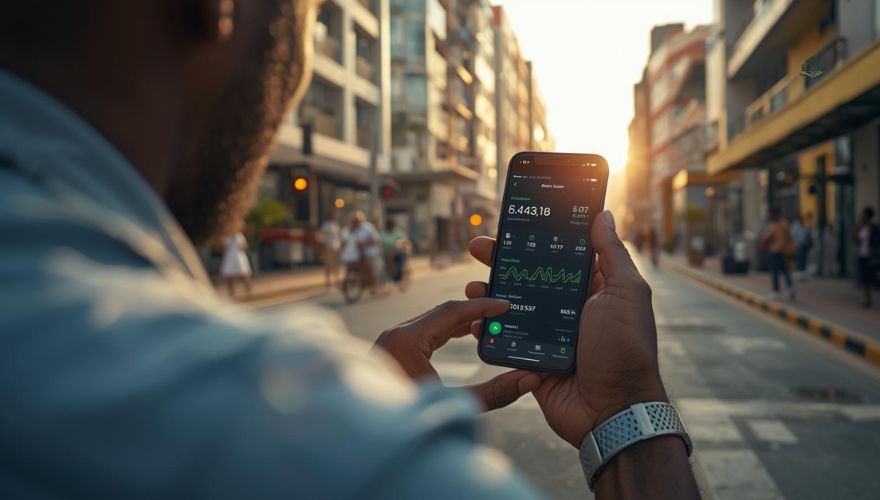
The fast development of the Islamic Banking Apps in Africa has hit a turning point in 2026 when it will cease to be an alternative option but will become a formidable financial force. These platforms are also using fintech innovation to close the enormous financial inclusion divide among millions of unbanked people in the continent as the digital economy in the continent takes off.
These mobile solutions offer a clear and ethical system that substitutes the conventional and unfair interest-based systems with fair system of profit sharing by strictly following Sharia-compliant principles of finance. Digital Islamic finance is not only convenient today, but a socio-economic driver that promotes trust and stability in a wide range of African markets, including Nigeria with its high-tech centers and Kenya with its rural areas.
What Is Islamic banking and how can Apps make it easier in Africa?
The most important aspect of this digital revolution is to understand the essence of Islamic banking. It is founded upon Sharia-compliant finance, and that is strictly forbidden to charge interest (riba), excessive uncertainty (gharar), and unethical investments (haram sectors). Instead of the profit which is interest based, profit and loss sharing is applied and a more balanced and justice driven financial environment is achieved.
Even with the 2026 influx of smartphone penetration and 5G connectivity in the African hubs Islamic mobile banking has gotten incredibly sophisticated. These applications enable the digital Islamic finance to be available to all; small-scale traders in Lagos and tech-savvy students in Nairobi. The contribution of fintech is currently monumental, and it is a combination of classic principles and AI-based individualism. These applications today provide real-time, instant creation of Sharia-compliant accounts, real-time, Halal-verified transfers, and automated Zakat management.
Top Islamic Banking Apps in Africa (2026 Updated List)
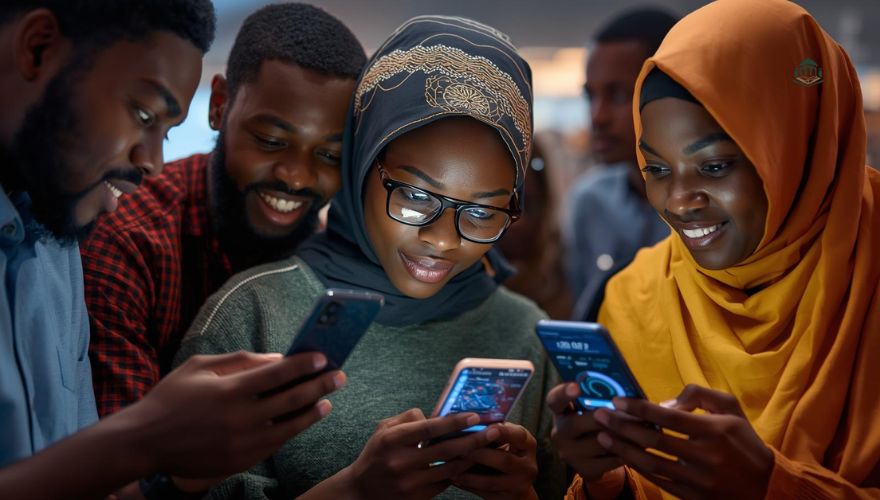
The 2026 landscape shows exponential growth in African Islamic fintech. Developers are now integrating AI assistants and Blockchain transparency to ensure users experience the best Sharia-compliant services. Here is the updated performance and rating list for the leading apps:
| App Name | Country | Launch Year | Key 2026 Feature | Rating (2026) |
| JaizMobile Plus | Nigeria | 2021 | AI-Powered Halal Savings | 4.9 |
| BSI Digital | Kenya | 2022 | Blockchain Micro-Finance | 4.7 |
| FawryPay Islamic | Egypt | 2023 | Integrated Zakat & Takaful | 4.8 |
| Al Baraka Digital | South Africa | 2024 | Global Ethical Portfolios | 4.6 |
Each of these popular apps has evolved significantly by 2026. Nigeria’s JaizMobile Plus now uses AI to help users optimize their halal savings. Kenya’s BSI Digital has expanded into blockchain-backed small business funding. Egypt’s FawryPay Islamic has become a one-stop-shop for charity and Takaful (Islamic insurance). Meanwhile, South Africa’s Al Baraka Digital connects users with sustainable, ESG-aligned ethical investments, proving that Africa is a global leader in the fintech transformation.
Features That Make These Apps Truly Sharia-Compliant
True Sharia-compliance in 2026 is about more than just “no interest”—it’s about a complete ethical architecture. These apps use sophisticated algorithms to ensure profit-sharing is calculated transparently, giving users fair returns while strictly following halal principles.
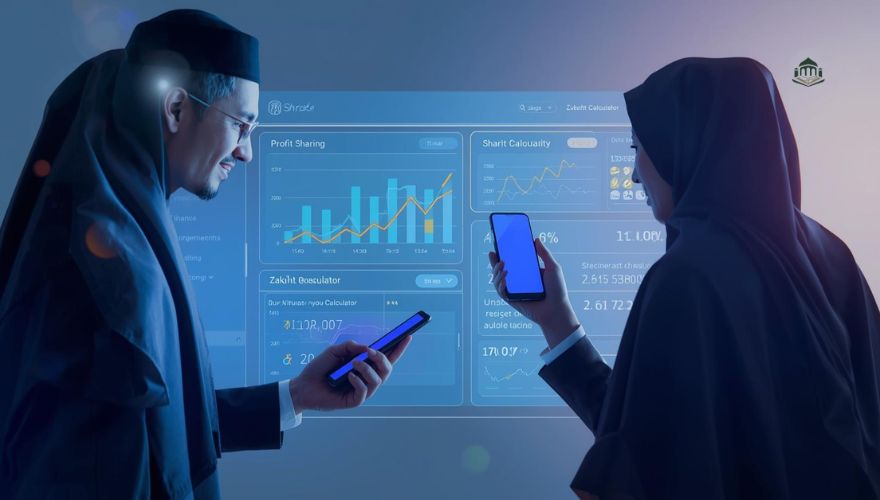
Key Islamic ethical finance features now include:
- Smart Zakat Calculators: Automated tools that sync with your balance to calculate and distribute Zakat instantly.
- Halal Investment Filters: AI-driven screens that automatically block any investment in alcohol, gambling, or high-debt companies.
- Transparent Smart Contracts: Using blockchain to ensure every contract is clear, with no hidden fees or “gharar” (uncertainty).
- Interest-Free Micro-Loans: Innovative “Qard al-Hasan” (benevolent loan) features for emergency needs.
This level of transparency in Islamic fintech means that users can have total confidence that their digital footprint aligns with their spiritual values.
Nigeria, Kenya, Egypt, and South Africa: 2026 Overview
- Nigeria: the Islamic banking in Nigeria is on a boom. Through government incentives of 2026, applications such as Jaiz Mobile are infiltrating rural populations, making even rural people financially included.
- Kenya: Here, the narration is propelled by the Silicon Savannah. Kenya has incorporated the use of the Islamic applications to its already established mobile money giants that enable small businesses to make seamless halal transitions.
- Egypt: Egypt is on the forefront of the Digital Sharia push, taking the government-supported fintech efforts, combined with the wisdom of traditional banking, to establish a powerful Islamic ecosystem.
- South Africa: This is the area where Sustainable and Ethical Investing will be targeted in 2026, where even non-Muslim investors are more willing to embrace transparent and risk-sharing models.
The African Fintech Market 2026 has a current value of more than $60 billion and the Islamic division of the market is one of the most rapidly developing, which proves that ethics and profit may coexist.
User Experience and Security: How Reliable Are These Apps in 2026?
In 2026, security is the top priority. User reviews show high satisfaction because these apps have moved beyond simple passwords. Most now feature Biometric 2.0 (Face & Voice ID) and Sharia Audit Trails—a digital log that proves every transaction was compliant.
Reliability has improved by nearly 50% since 2024, thanks to cloud-native infrastructure. Data privacy is strictly enforced, ensuring that transactions remain private and secure from cyber threats.
| App | User Rating | Security Score | Main Protection (2026) |
| JaizMobile Plus | 4.9 | 98% | Biometric + AI Fraud Shield |
| BSI Digital | 4.7 | 96% | Blockchain Encryption |
| FawryPay Islamic | 4.8 | 97% | Real-time Sharia Auditing |
| Al Baraka Digital | 4.6 | 95% | Multi-Factor Authentication |
Comparing Conventional and Islamic Banking Apps
The gap between Islamic vs Conventional banking in Africa has widened in terms of ethics. While conventional apps still rely on interest-based debt, Islamic apps focus on Equity and Asset-based finance. In 2026, more people are choosing the Islamic model because it offers a “Safety Net” where risks are shared, rather than being pushed entirely onto the customer.
| Feature | Conventional Banking | Islamic Banking (2026) |
| Interest (Riba) | Charged/Paid | Strictly Prohibited |
| Risk Factor | Customer carries the burden | Shared (Partnership Model) |
| Investment | Anything goes | Only Halal & ESG Sectors |
| Tech Focus | Profit maximization | Ethical Inclusion & Fairness |
Future Outlook (2026–2030): The AI & Blockchain Era
The future looks incredibly bright. By 2030, we expect AI to fully automate ethical wealth management. Blockchain Islamic Finance will likely make cross-border halal remittances instant and nearly free. As Islamic investment platforms grow, they are attracting a global audience looking for “Socially Responsible Investing” (SRI).
Africa’s Islamic Economy 2026 is setting the blueprint for the rest of the world, showing how to build a financial system rooted in morality, powered by the latest technology.
Final Thoughts: Building Bridges to Equality
The impact of Islamic Banking Apps in Africa goes far beyond your phone screen. These applications are combating poverty by targeting the unbanked and offering those solutions with which to expand. They empower women, younger people and entrepreneurs, providing them with a fair opportunity without engaging in high-interest debt. By 2026 and after, these apps will not be merely a financial instrument; they will be a pathway to a better and more prosperous future of mutual justice. Africa is demonstrating that the future of finance is not only digital it is ethical by integrating Sharia law and 2026 innovation.
FAQs
Why are Islamic Banking Apps better than normal apps in 2026?
They offer a fairer “Profit-Sharing” model and use AI to ensure every penny is invested ethically.
Do non-Muslims have access to these apps?
They are absolutely transparent and ethical investment filters used by non-Muslims in Africa.
Do these applications resist 2026 cyber threats?
Yes, they have high-level encryption and biometric security that is up-to-date to 2026 standard.
Is African Islamic fintech fast-growing?
Yes, it is already doing better than traditional fintech expansion in such nations as Nigeria and Kenya.
Do these apps help with Zakat?
Yes, the majority of 2026 updates will have automated Zakat calculators, and direct links to reviewed charities.
